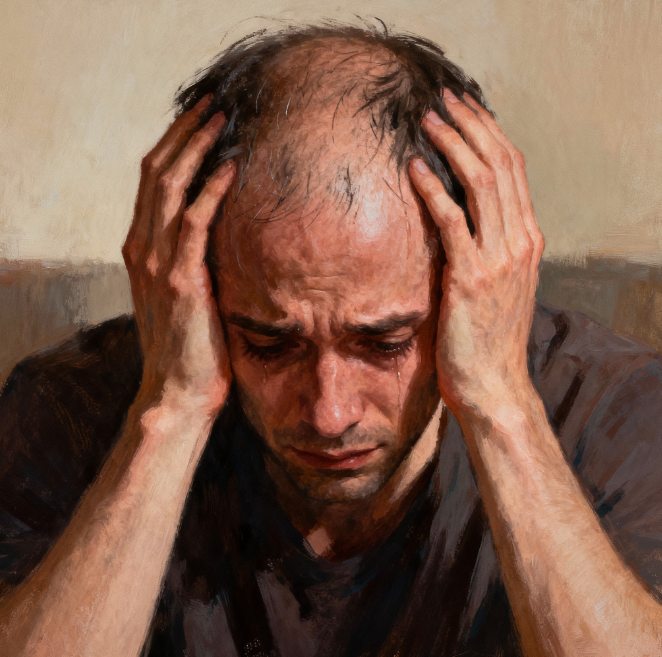
Hair loss is more than a physical change. This deep dive explores the silent shame, grief, and anxiety that accompanies thinning hair, and offers a path toward reclaiming your confidence and sense of self.
DISCLOSURE:
As an ClickBank Affiliate, I earn commissions from qualifying purchases made through links in this article. This income supports my research and content creation. Please understand that I recommend this product because I believe in its quality and benefits, and after conducting thorough research.

Introduction: More Than Just Hair
It starts subtly. A few extra strands in the drain. A widening part that seems a little too bright under the bathroom lights. A ponytail that feels thinner in your hand. For millions of Americans, this is the beginning of a quiet, often solitary, struggle.
In a society that often equates a full head of hair with youth, vitality, and attractiveness, losing it feels like losing a part of your identity. While we frequently discuss hair loss in terms of treatments and solutions, we rarely acknowledge the profound emotional earthquake that rumbles beneath the surface.
This isn’t a vanity issue. This is a deeply human issue of self-perception, grief, and social anxiety. This article isn’t just about hair follicles; it’s about the person attached to them. We will give voice to the silent suffering, validate your feelings, and explore not just how to nourish your hair, but how to heal your confidence.
The Unspoken Grief: When Your Reflection Betrays You
Hair is inextricably linked to our identity. It’s one of the first things people notice about us and a primary tool for self-expression. When it begins to thin, it can feel like a betrayal by your own body. This loss often triggers a genuine grieving process, similar to losing anything else of value.
The Stages of Hair Loss Grief:
- Denial: “It’s just a bad haircut.” “It’s seasonal shedding.” We explain away the early signs, refusing to believe what is happening.
- Anger: Frustration builds. “Why is this happening to me?” You might feel anger at your genetics, your body, or even at others who have the hair you desire.
- Bargaining: “If I just use this special shampoo, take these vitamins, stop washing it so often, then it will stop.” This stage is filled with frantic searches for a miracle cure.
- Depression: This is when the emotional weight truly settles. It’s the sadness of seeing old photos, the dread of windy days, and the feeling of being somehow less than.
- Acceptance: This final stage isn’t about giving up. It’s about acknowledging the reality of the situation and making a conscious choice to move forward, whether that means embracing your new look or proactively seeking a solution that works for you.
Many people get stuck in the depression stage because the emotional toll is never addressed. It’s treated as a superficial concern, when in reality, it cuts to the core of who we are.
The Invisible Weight: 5 Specific Emotional Impacts of Hair Thinning
1. The Erosion of Self-Confidence
Your confidence can feel as thin as your hair. What was once an unconscious asset becomes a source of constant self-monitoring.
- The Pre-Occupation: You find yourself constantly thinking about your hair. Is the thinning visible? Is the wind blowing it the wrong way? This mental loop drains cognitive energy that could be spent on work, family, and hobbies.
- The Disappearing Act: You start declining invitations. A pool party? Too risky. A beach vacation? The wind and water will expose you. Social spontaneity becomes a casualty of hair loss.
- The Professional Hesitation: A study published in the Journal of Applied Social Psychology found that individuals with visible hair loss are often perceived as older and less confident. Whether this perception is real or imagined, it can lead to anxiety about public speaking, client meetings, or seeking a promotion.
2. Social Anxiety and the Fear of Judgment
Social situations transform from sources of joy into minefields of potential humiliation.
- The “Hair Position” Paranoia: You become a master of strategic styling and positioning. You always seek the “good light” and sit in places where your thinning crown isn’t visible. You avoid sitting with your back to people.
- The Group Photo Dread: The simple request for a group photo can trigger a wave of anxiety. You nervously laugh and try to stand in the back, angling your head just so, only to spend the next hour anxiously waiting to see the result.
- The Unsolicited Advice: Well-meaning friends and family might offer “helpful” tips about miracle cures or simply say, “Just shave it all off!” Each piece of advice, while likely coming from a good place, serves as a reminder of your perceived flaw and can feel deeply isolating.
3. Intimacy and Romantic Insecurity
For many, this is the most painful arena. The vulnerability of intimacy is magnified when you feel physically insecure.
- The Bedroom Anxiety: The fear of your partner seeing your scalp under the harsh bedroom light, or finding your hairs on the pillow, can create a barrier to intimacy. You may find yourself wanting to keep hats on or avoid certain positions.
- The Dating Scene Terror: For those re-entering the dating world, hair loss can feel like a devastating handicap. Profile pictures become a carefully curated gallery of angles and hats. The thought of a first kiss under bright restaurant lighting is fraught with anxiety.
- The Feeling of Being “Less Desirable”: This internal narrative can be incredibly damaging. You might feel you are no longer attractive to your partner or potential partners, leading to withdrawal and loneliness. As one HairFortin user, Jason T., poignantly shared: “I had nightmares where my wife and her friends were laughing at me because I was ‘a pitty, little man’.” This is the raw, unfiltered fear that hair loss can instill.
4. The Constant, Draining Vigilance
Hair loss forces you into a state of hyper-awareness about your appearance. This isn’t vanity; it’s a survival mechanism.
- The Mirror Check: You don’t just glance in the mirror; you inspect. You check your hairline, your part, your crown from multiple angles, multiple times a day.
- The Shedding Count: Every hair in the shower, on your pillow, or on your shoulders is counted and mourned. A “good day” is defined by fewer hairs lost.
- The Environmental Scan: You walk into every room assessing the lighting, the presence of mirrors, and the potential for wind. This constant scanning is mentally and emotionally exhausting.
5. The Isolation of Silent Suffering
Perhaps the most damaging aspect is the loneliness. Our culture often dismisses hair loss as a “first-world problem” or a male-centric issue, which is profoundly inaccurate. Women experience this grief just as deeply, if not more so, due to even greater societal pressures.
People suffering in silence believe they are alone. They scroll through social media feeds filled with perfect hair and assume no one could understand their private pain. This silence prevents them from seeking support, both emotionally and practically.
You Are Not Alone: Breaking the Silence
If you see yourself in these words, please know this: your feelings are valid. You are not vain, and you are not overreacting. You are responding to a real and significant change in your appearance and identity. Acknowledging this pain is the first step toward reclaiming your power.
From Grief to Action: Reclaiming Your Narrative
Moving forward requires a dual approach: tending to your emotional well-being and making informed, empowered decisions about your hair health.
The Mindset Shift: Strategies for Emotional Resilience
- Name It to Tame It: Acknowledge your feelings. Say them out loud: “I feel sad about my hair loss.” “I am anxious about that event.” Verbalizing the emotion robs it of some of its power.
- Reframe Your Identity: Your hair is a part of you, but it is not all of you. Make a list of your qualities, skills, and values that have nothing to do with your appearance. Are you a kind friend? A dedicated parent? A creative problem-solver? Re-anchor your self-worth in these unshakable pillars.
- Seek Support, Not Solitude: Confide in a trusted friend, partner, or family member. You will likely be surprised by their empathy. Consider joining online support groups or forums where people share their experiences. Seeing thousands of others sharing your exact fears can be incredibly liberating.
- Control What You Can: Focus on aspects of your health and appearance that are within your control. Adopt a nutrient-rich diet, establish a consistent exercise routine, and cultivate a grooming style that makes you feel good, whether that involves strategic haircuts, hats you love, or exploring headwraps and scarves.
The Practical Path: Addressing the Physical Cause with Compassion
While working on your mindset, it is equally valid and empowering to seek a physical solution. The key is to move from frantic “bargaining” to informed, proactive care. The goal is to find a solution that addresses the problem from the inside out, aligning with your body’s natural processes.
An In-Depth Look at an Inside-Out Approach: HairFortin
In my research for solutions that understand this mind-body connection, I was struck by the story and formulation of HairFortin. It emerged not from a faceless corporation, but from a place of professional understanding and personal empathy.
The Origin: A Pharmacist’s Mission
HairFortin was developed by James Green, a practicing pharmacist from Texas. In his daily work, he witnessed the cycle of hope and disappointment his customers experienced with over-the-counter hair solutions. He saw not just the financial cost, but the emotional one. He wasn’t just a formulator; he was a frontline witness to the silent struggle we’ve been discussing. This professional experience, coupled with his own personal experimentation, led him to create a formula focused on foundational, internal support.
Why HairFortin’s Philosophy Resonates:
- It’s Rooted in Nutritional Support: Hair loss, regardless of the initial trigger, often creates a poor environment for hair follicles. They become starved of essential nutrients and inflamed. HairFortin’s approach is to flood the body with the raw materials needed to rebuild and support the hair growth cycle from within. Its formula contains 28 plant extracts and vitamins, recognizing that hair health is a complex process requiring a symphony of nutrients, not a single magic bullet.
- A Commitment to Purity and Potency: The emotional journey is hard enough without wondering if your supplement is part of the problem. James Green’s background as a pharmacist is evident here. He emphasizes the sourcing of ingredients. For example, the Fo-Ti (a renowned herb in traditional practices for hair) in HairFortin is wild-harvested and grown for 8 years, unlike the young, chemically-treated Fo-Ti commonly found. This commitment to quality ensures your body is getting bioavailable, potent ingredients it can actually use.
- Manufacturing You Can Trust: The capsules are produced in the USA in an FDA-approved and GMP-certified facility. For anyone feeling vulnerable and skeptical after trying failed solutions, this third-party validation provides a crucial layer of trust and safety.
- Addressing a Visible Sign of Stress and Aging: The free bonus, HairFortin AgePop, is a thoughtful addition. It targets gray hair, which is another common source of self-consciousness and a visible marker of oxidative stress on the body. It shows an understanding that the goal for many is not just more hair, but healthier, more vibrant hair.
Real Stories, Real Reclaiming of Confidence
While data is important, stories resonate. The testimonials for HairFortin often speak to the emotional liberation that comes with physical improvement.
- Thomas F., 42, Kentucky: “Both me and my wife wanted something that could support our natural hair growth. It was incredibly hard for me but I could tell that for her was devastating. Now, after 7 years of searching, it’s like we’re born again.” This speaks to the shared emotional burden and the profound relief of finding a solution that works for both partners.
- Jason T., 50, Kentucky: “Thank God I’m not like that anymore. The best thing: I have a lot less grey hairs. How about that?” His story directly mirrors the nightmare scenario many fear, and his outcome represents a reclaiming of not just hair, but peace of mind.
These accounts suggest that users are experiencing a restoration that goes beyond the physical—they are regaining a sense of control and normalcy.
Your Journey Toward Healing Begins With a Single Step
The emotional toll of hair thinning is real, heavy, and deserves to be taken seriously. You have already taken a brave step by reading this and acknowledging the depth of this experience.
You have a right to feel good in your own skin. You have a right to seek solutions that help you feel whole and confident again. Whether that journey involves a profound mindset shift, a proactive approach to hair health, or—most likely—a combination of both, the power to move forward is in your hands.
If providing your body with high-quality, targeted nutritional support feels like an empowering next step for you, then it is time to educate yourself on the best possible options.
We invite you to continue your research by visiting the official HairFortin website. There, you can examine the full, science-backed ingredient list, read more about the philosophy of its pharmacist-creator, and see if this comprehensive, internal approach aligns with your goals for hair health and overall well-being.
Given the care taken in sourcing its natural ingredients, stock can be limited.

Click Here to Visit the Official HairFortin Website – Learn More About Its Natural Formula
A Final, Compassionate Note
This article was written to provide insight and support. It is based on psychological research, user testimonials, and analysis of the product’s stated formulation. However, it is not medical advice. The emotional impact of hair loss can be severe, and if you are experiencing signs of depression or anxiety that are impacting your daily life, please consult a mental health professional.
Always speak with your physician or a qualified healthcare provider before starting any new supplement, like HairFortin, to ensure it is appropriate for your individual health needs. HairFortin is a dietary supplement. These statements have not been evaluated by the Food and Drug Administration. This product is not intended to diagnose, treat, cure, or prevent any disease. Individual results will vary, but the goal remains the same: to support you on your path to feeling like yourself again.
READ ALSO THE ARTICLE TITLED:
Leave a Reply