Dive deep into the world of cartilage, your body’s essential shock absorber. Learn how it works, why it wears down, and the proactive steps you can take to protect and support it for lifelong joint health.
Introduction: The Silent Guardian of Your Joints
Think about the last time you jumped off a step, went for a run, or even just walked down the street. With every step, forces greater than your body weight travel through your skeleton. Yet, you likely didn’t feel a jarring impact. Why? Because of a silent, unsung hero working tirelessly within your joints: your cartilage.
This smooth, glistening tissue is the ultimate shock absorber and friction-reducer in your body. But unlike a bruise that heals or a bone that mends, cartilage has a notoriously limited ability to repair itself. Once it’s gone, it’s often gone for good.
This article is your definitive guide to cartilage. We will demystify what it is, how it works, and—most importantly—how you can protect and nourish this critical tissue to maintain an active, pain-free life for decades to come. Understanding your cartilage is the first step toward becoming a proactive guardian of your own joint health.
Section 1: What Is Cartilage? More Than Just “Cushioning”
While it’s often described as a “cushion,” cartilage is a specialized, robust, and complex connective tissue. Its unique structure is what allows it to perform its remarkable functions.
The Three Types of Cartilage in the Human Body
It’s crucial to know that not all cartilage is the same. Your body contains three primary types:
- Hyaline Cartilage (Articular Cartilage): This is the star of the show for joint health. It’s the smooth, white, glistening tissue that covers the ends of bones where they meet to form a joint (like your knees, hips, and shoulders). Its primary role is to provide a smooth, low-friction surface for movement and to absorb shock. When people talk about “cartilage wear” in arthritis, they are referring to the degradation of hyaline cartilage.
- Fibrocartilage: This type is tougher and more fibrous, containing thick bundles of collagen. It’s designed for strength and durability. You find fibrocartilage in the menisci of the knees and the discs between your vertebrae—structures that need to withstand compression and shear forces.
- Elastic Cartilage: As the name suggests, this cartilage is more flexible. It contains elastin fibers, giving it a yellow appearance and the ability to spring back into shape. It supports structures that need both strength and flexibility, like your external ears and epiglottis.
For the rest of this article, when we refer to “cartilage,” we will be focusing on hyaline (articular) cartilage, as it is most critical for joint mobility and comfort.
The Unique Architecture of Articular Cartilage
To appreciate why cartilage is so vulnerable, you need to understand its brilliant but fragile design. It’s mostly a matrix—a scaffold—made up of:
- Collagen Fibers (Mostly Type II): These are incredibly strong protein fibers woven into a dense network. They provide the cartilage with its tensile strength, creating a mesh that resists being pulled apart.
- Proteoglycans: These are large, “bottle-brush”-shaped molecules that are trapped within the collagen network. They attract and hold vast amounts of water.
- Chondrocytes: These are the living cells of the cartilage. They are responsible for producing and maintaining the collagen and proteoglycan matrix. Think of them as the lone maintenance workers in a vast, sprawling factory.
The magic is in the interaction of these components. The proteoglycans, by holding water, create a swelling pressure. This pressure is constrained by the resilient collagen network. The result is a tissue that is both hydrated and firm—a perfect, compressible shock absorber that is also incredibly smooth and slippery, with a friction coefficient lower than ice on ice.
Section 2: The Critical Functions of Cartilage: Why It’s Non-Negotiable
Cartilage isn’t just a passive cushion; it’s a dynamic and active component of a healthy joint system.
1. Shock Absorption: Your Personal Suspension System
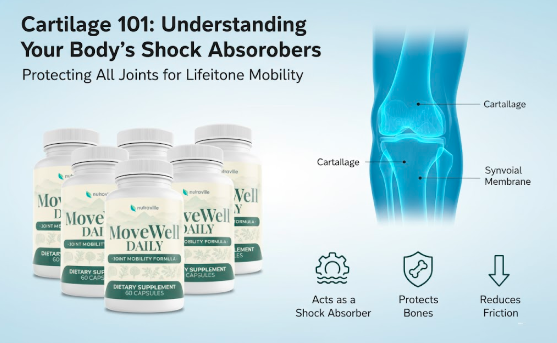
Every step you take sends a shockwave up your leg. Cartilage compresses to dissipate this force, protecting the underlying bone from stress fractures and damage. Without this buffer, the immense forces of daily life would literally grind our bones to dust.
2. Frictionless Movement: The Body’s Ball-Bearing System
The combination of the ultra-smooth cartilage surface and the lubricating synovial fluid creates a near-frictionless environment within the joint. This allows for fluid, pain-free movement. When cartilage is healthy, you don’t even notice it’s there—which is exactly how it should be.
3. Load Distribution: Spreading the Weight
Cartilage doesn’t just absorb shock; it distributes forces evenly across the joint surface. This prevents excessive pressure on any single point of the underlying bone, which is essential for long-term joint integrity.
Section 3: The Cartilage Crisis: How and Why It Wears Down
Cartilage damage is often a slow, insidious process. Understanding the “why” is key to prevention.
The Achilles’ Heel: Avascularity and Limited Healing
The single biggest challenge with cartilage is that it is avascular (no blood vessels) and aneural (no nerves). This has two critical implications:
- Slow Nutrient Delivery: Without a direct blood supply, chondrocytes must get their nutrients and oxygen through diffusion from the synovial fluid. This process is slow and inefficient.
- Limited Repair Capacity: When injured, the body’s standard repair kit—blood, inflammatory cells, and growth factors—can’t get to the site quickly. The few resident chondrocytes struggle to produce enough new matrix to repair significant damage.
Primary Causes of Cartilage Degradation
- Osteoarthritis (OA): This is the most common culprit. Often called “wear-and-tear” arthritis, OA involves the progressive breakdown of articular cartilage. It’s not just mechanical wear; it’s a whole-joint disease characterized by low-grade inflammation that disrupts the balance between cartilage breakdown and repair.
- Acute Injury (Trauma): A sudden twist, a fall, or a sports injury can cause a tear in the cartilage (like a meniscal tear) or a focal defect in the articular surface. This creates a “pothole” in the once-smooth landscape, leading to accelerated wear.
- Chronic Inflammation: Inflammatory autoimmune conditions like Rheumatoid Arthritis (RA) are particularly destructive. The immune system mistakenly attacks the synovial membrane, releasing a flood of inflammatory chemicals (cytokines) that actively break down the cartilage matrix.
- Biomechanical Issues: Misalignments like being bow-legged or knock-kneed, or having a history of injuries that alter your gait, can place uneven pressure on cartilage, causing it to wear down faster in specific areas.
- Obesity: This is a major mechanical and inflammatory risk factor. More weight means more direct compression on weight-bearing joints. Furthermore, fat tissue produces inflammatory cytokines that can circulate and degrade cartilage.
Section 4: The Vicious Cycle of Cartilage Loss and Osteoarthritis
Cartilage damage often initiates a destructive feedback loop that is difficult to break:
- Initial Insult: An injury, inflammation, or biomechanical issue causes the cartilage surface to roughen.
- Increased Friction: The rough surface creates more friction during movement, leading to further cartilage breakdown and the release of debris.
- Synovial Inflammation: The cartilage debris irritates the synovial lining, causing inflammation (synovitis). The inflamed synovium then produces enzymes that further break down cartilage.
- Pain and Stiffness: This inflammation causes pain, swelling, and stiffness, leading you to move less.
- Muscle Weakness and Reduced Lubrication: Reduced movement leads to muscle atrophy (weakening the joint’s natural “corset”) and less circulation of synovial fluid (starving the cartilage of nutrients).
- Further Degradation: The weaker muscles provide less support, and the malnourished cartilage is less able to repair itself, leading to even more breakdown.
Breaking this cycle requires a proactive, multi-pronged approach.
Section 5: The Proactive Protocol: How to Protect and Support Your Cartilage
You are not a passive bystander in the health of your cartilage. The following strategies form a powerful protocol for preservation.
1. Movement as Medicine: Load It to Nourish It
Contrary to the myth that exercise “wears out” joints, the right kind of movement is essential for cartilage health. Remember, movement pumps synovial fluid in and out of the cartilage, delivering nutrients and removing waste.
- Low-Impact Cardiovascular Exercise: Swimming, cycling, elliptical training, and walking are ideal. They provide the rhythmic loading and unloading that cartilage needs without excessive impact.
- Strength Training: This is non-negotiable. Strong muscles around a joint act as secondary shock absorbers, offloading significant stress from the cartilage itself. Focus on strengthening the quadriceps for knee health, the glutes and core for hip and back health.
- Range-of-Motion Exercises: Activities like yoga and Tai Chi maintain joint flexibility, prevent stiffness, and ensure full cartilage contact for even nutrient distribution.
2. Weight Management: The Single Most Effective Intervention
For weight-bearing joints, losing weight is like removing a heavy backpack you’ve been carrying every single day. Studies show that losing just one pound of body weight reduces four pounds of pressure on the knees. It’s the most powerful modifiable risk factor for preventing and managing osteoarthritis.
3. Anti-Inflammatory Nutrition: Fuel for Repair
Your diet directly influences the inflammatory environment in your body.
- Embrace:
- Omega-3 Fatty Acids: Found in fatty fish (salmon, sardines), flaxseeds, and walnuts. They are potent inflammation fighters.
- Colorful Fruits and Vegetables: Packed with antioxidants (Vitamins C, E) that combat oxidative stress, a key driver of cartilage damage.
- Spices: Turmeric (curcumin) and ginger have powerful natural anti-inflammatory properties.
- Avoid: Limit processed foods, refined sugars, and excessive saturated fats, which can promote systemic inflammation.
Section 6: Bridging the Gap: The Science of Cartilage-Supporting Supplements
While a healthy lifestyle is the foundation, getting the specific, therapeutic levels of nutrients needed for cartilage support from diet alone can be difficult. This is where evidence-based supplementation can play a crucial role.
The goal of a good cartilage supplement is to provide the raw materials the chondrocytes need to build and maintain the cartilage matrix.
The most researched ingredients include:
- Glucosamine Sulfate: This is a fundamental building block for proteoglycans. It provides the “bottle-brush” handles that hold water in the cartilage. Numerous studies suggest it can help slow cartilage degeneration and alleviate osteoarthritis symptoms.
- Chondroitin Sulfate: This is a major component of the proteoglycan molecule itself. It gives cartilage its compressibility and helps inhibit enzymes that break down cartilage. It often works synergistically with glucosamine.
- MSM (Methylsulfonylmethane): MSM provides a bioavailable source of sulfur, a critical mineral for forming the collagen cross-links that give the matrix its strength. It also possesses notable anti-inflammatory and antioxidant properties.
- Collagen Peptides (Undenatured Type II): Emerging research suggests that specific types of collagen supplements can provide bioactive peptides that may help modulate the immune system’s attack on cartilage and stimulate the chondrocytes to produce new matrix.
A Closer Look at a Comprehensive Formulation: MoveWell Daily
When evaluating a supplement for cartilage support, it’s wise to look for a formula that addresses multiple facets of the problem: providing building blocks, supporting the synovial environment, and managing inflammation.
MoveWell Daily is one such product whose ingredient profile is designed for this comprehensive approach. Let’s analyze its relevance to cartilage health:
- Direct Matrix Support with Glucosamine and Chondroitin: This is the core of its cartilage-support strategy. By supplying these fundamental substrates, MoveWell Daily provides the chondrocytes with the raw materials they desperately need to maintain and repair the proteoglycan-rich matrix. This helps the cartilage retain water and stay hydrated and resilient.
- Structural Integrity and Inflammation Control with MSM: The inclusion of MSM is a significant advantage. The sulfur it provides is essential for forming strong, flexible collagen fibers. Furthermore, by helping to manage the underlying inflammatory processes that drive cartilage breakdown, MSM helps create a healthier joint environment for the chondrocytes to do their work.
- A Synergistic, Proactive Approach: The combination of these key ingredients in a daily formula represents a proactive strategy. It’s not about waiting for pain to become severe; it’s about consistently providing nutritional support to help the body maintain its cartilage before significant degradation occurs.
Affiliate Transparency & Important Disclaimer: I am an affiliate for MoveWell Daily. My recommendation is based on a thorough analysis of its formulation against the established scientific literature on cartilage biology. I believe it represents a well-rounded approach to joint nutrition. However, it is crucial to consult with your healthcare provider before starting any new supplement, especially if you have pre-existing health conditions, are pregnant or nursing, or are taking other medications, particularly blood thinners. They can help you determine if it is appropriate for your specific situation.
Section 7: Medical Interventions: When Cartilage Damage Is Advanced
When cartilage loss is severe, medical interventions may be necessary. These are typically considered after conservative measures have been exhausted.
- Viscosupplementation: Injections of hyaluronic acid into the joint to supplement the synovial fluid and improve lubrication.
- Corticosteroid Injections: Powerful anti-inflammatory injections to provide short-term pain relief during severe flares.
- Arthroscopic Debridement: A surgeon uses a scope to “clean up” the joint, smoothing ragged cartilage and removing debris.
- Cartilage Restoration Procedures: These include techniques like microfracture (stimulating bone marrow to create new scar-like cartilage), autologous chondrocyte implantation (transplanting your own cultured cartilage cells), and osteochondral grafting (transplanting plugs of bone and cartilage). These are typically for younger patients with focal defects.
- Joint Replacement (Arthroplasty): In end-stage arthritis, the damaged joint surfaces are replaced with metal and plastic implants. This is a highly successful procedure for relieving pain and restoring function when the native cartilage is gone.
Conclusion: Be the Steward of Your Cartilage Health
Your cartilage is a remarkable, yet fragile, tissue. It allows you to move through the world with grace and ease, asking for nothing in return except your conscious care. Unlike other tissues, it cannot cry out in pain until the damage is already significant, and it has a very limited ability to heal itself.
The power to protect it lies in a proactive, consistent approach:
- Move smartly and consistently to nourish it.
- Manage your weight to offload it.
- Eat an anti-inflammatory diet to create a healthy environment for it.
- Consider targeted supplementation to provide the dedicated building blocks it needs for long-term maintenance.
Your joints are designed to last a lifetime. By becoming an informed and active steward of your cartilage health today, you are making a direct investment in your mobility, independence, and quality of life for all your tomorrows.
Are you ready to take a proactive step in providing your cartilage with the essential nutrients it needs to stay healthy and resilient?
A comprehensive formula like MoveWell Daily is designed to support the intricate biology of your joints from the inside out. Click the link below to visit the official website, where you can delve deeper into the research, understand the full ingredient profile, and make an informed decision for your joint health journey.

Visit the Official MoveWell Daily Website to Learn More and Explore Your Options!

Medical Disclaimer:
This content is for informational purposes only and does not substitute for professional medical advice. Always consult a qualified healthcare provider with any questions regarding a medical condition or treatment plan. Individual results may vary.
READ ALSO THE ARTICLE TITLED:
The Ultimate Guide to Synovial Fluid: Your Joint’s Natural Lubricant
Leave a Reply