Worried about your memory lapses? This guide helps you distinguish between normal age-related forgetfulness and signs that warrant a doctor’s visit. Learn the 10 key differences and the proactive steps you can take for your brain health.
DISCLOSURE:
As an ClickBank Affiliate, I earn commissions from qualifying purchases made through links in this article. This income supports my research and content creation. Please understand that I recommend this product because I believe in its quality and benefits, and after conducting thorough research.
That moment of panic in a parking lot when you can’t remember where you parked. The frustration of walking into a room only to forget why you went in there. The name of a favorite actor that’s stuck on the tip of your tongue.
These experiences are universal, but as we get older, they can trigger a wave of anxiety. A silent question forms in the back of our minds: Is this just normal aging, or is it the beginning of something serious?
This worry is one of the most common concerns doctors hear from patients over 40. The fear of cognitive decline, particularly Alzheimer’s disease or other forms of dementia, is profound. It’s a fear that can overshadow the normal, manageable changes that come with a life well-lived.
The good news is that for the vast majority of people, these memory lapses are a normal part of the brain’s aging process. The key is learning to distinguish between the typical “senior moments” and the red flags that signal it might be time to seek professional guidance.
This article will serve as your comprehensive guide. We will explore the science of memory and aging, provide a clear, side-by-side comparison of normal versus concerning signs, and outline the powerful, proactive steps you can take to protect your cognitive health starting today.
The Aging Brain: What’s Normal?
First, it’s essential to understand that some cognitive changes are a normal and expected part of aging, much like wrinkles on the skin or a slower metabolism. Your brain is not the same at 60 as it was at 20, and that’s okay.
Neurologists often compare the aging brain to a computer that has been running for decades. The hardware is still good, but it might take a little longer to boot up, retrieve a file, or run multiple programs simultaneously.
Here’s what’s happening under the hood:
- Slower Processing Speed: The speed at which you process new information and react to it naturally slows down. This is why you might need a bit more time to learn a new smartphone app or understand a complex set of instructions.
- Mild Retrieval Delays: Your memory is like a vast, well-stocked library. With age, the “librarian” (your hippocampus) might take a bit longer to find the specific “book” (a memory or word) you’re looking for. The information is usually there; it just takes a moment longer to access.
- Increased Susceptibility to Interference: It becomes easier to get distracted. Trying to remember a grocery list while the TV is on and a dog is barking can be more challenging than it used to be.
These changes are gradual and typically don’t significantly interfere with your ability to work, live independently, or maintain your social life. They are annoyances, not disabilities.
The 10 Key Differences: Normal Forgetfulness vs. Concerning Signs
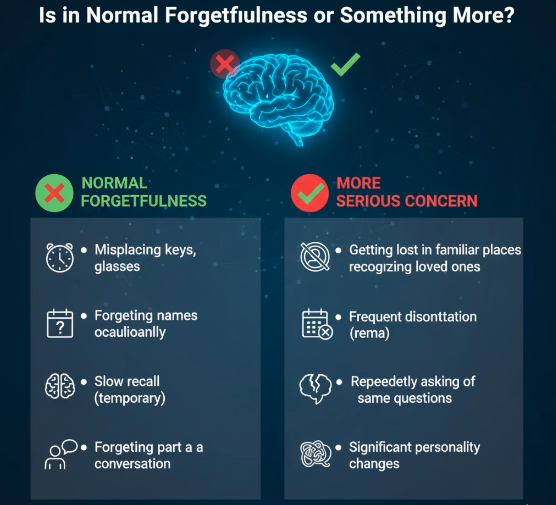
The table below is not a diagnostic tool, but a guide to help you understand the crucial distinctions. If you see yourself primarily in the “Normal Forgetfulness” column, you are likely experiencing typical age-related changes. A pattern of symptoms from the “Concerning Signs” column, however, warrants a conversation with your doctor.
| Aspect of Memory | Normal, Age-Related Forgetfulness | Potentially Concerning Signs |
|---|---|---|
| 1. Forgetting Recent Events | Occasionally forgetting names or appointments but remembering them later. | Consistently forgetting recently learned information and never recalling it. Forgetting important dates or events repeatedly. |
| 2. Problem-Solving Ability | Making occasional errors when balancing a checkbook. Needing a bit more time to learn a new recipe. | Significant challenges in developing and following a plan. Inability to work with numbers, like managing a monthly budget. Poor judgment with money, like falling for scams. |
| 3. Completing Familiar Tasks | Sometimes needing help to record a TV show or set a digital thermostat. | Struggling to complete routine tasks independently. Getting lost while driving a familiar route. Forgetting the rules of a favorite game you’ve played for years. |
| 4. Sense of Time & Place | Temporarily forgetting what day it is but figuring it out soon after. | Losing track of dates, seasons, and the passage of time. Forgetting where you are or how you got there. |
| 5. Visual & Spatial Relationships | Vision changes related to cataracts or presbyopia. | New difficulty with judging distance, determining color, or reading. Problems with balance or navigating stairs. |
| 6. Conversation & Vocabulary | Sometimes having trouble finding the right word. | Struggling to follow or join a conversation. Stopping mid-sentence with no idea how to continue. Repeating the same stories word-for-word. |
| 7. Misplacing Things | Losing your keys or glasses and being able to retrace your steps to find them. | Putting things in illogical places (e.g., keys in the refrigerator). Being unable to retrace steps to find lost items. Accusing others of stealing. |
| 8. Judgment & Decision-Making | Making a questionable decision occasionally, like an impulse buy. | Demonstrating consistently poor judgment. Paying less attention to grooming, personal safety, or financial responsibility. |
| 9. Social Withdrawal | Occasionally feeling tired of work, family, or social obligations. | Withdrawing from hobbies, social activities, or work projects significantly. Forgetting how to do a favorite hobby and avoiding it out of frustration. |
| 10. Mood & Personality | Developing specific ways of doing things and becoming irritable when a routine is disrupted. | Becoming confused, suspicious, depressed, fearful, or anxious easily. Getting upset more frequently, especially when outside their comfort zone. |
Beyond Alzheimer’s: Other Reversible Causes of Memory Problems
Before jumping to the worst-case conclusion, it’s vital to know that many medical conditions can mimic the symptoms of dementia. The encouraging news is that many of these are treatable. If you’re experiencing memory issues, your doctor will likely check for the following:
- Medication Side Effects: Certain drugs, especially when combined, can cause brain fog and memory issues.
- Vitamin B12 Deficiency: Crucial for nerve health, a deficiency can cause significant cognitive problems.
- Thyroid Problems: Both an underactive (hypothyroidism) and overactive (hyperthyroidism) thyroid can impair cognitive function.
- Dehydration: Especially in older adults, even mild dehydration can cause confusion and memory lapses.
- Depression and Anxiety: These conditions can profoundly affect concentration and memory, often presenting as “pseudodementia.”
- Sleep Apnea: This disorder, characterized by interrupted breathing during sleep, deprives the brain of oxygen and severely disrupts memory consolidation.
- Urinary Tract Infections (UTIs) in the Elderly: In older adults, a UTI can often present with sudden confusion, not the typical physical symptoms.
This is why Step #1 is always to consult a healthcare professional. They can run tests to rule out these reversible conditions and provide a clear path forward.
Your Proactive Plan: How to Protect Your Cognitive Health Now
Whether you’re experiencing normal forgetfulness or are concerned about your risk, the most powerful thing you can do is take proactive steps to support your brain health. The brain is not a static organ; it has a remarkable ability to adapt and grow, a quality known as neuroplasticity. You can influence your cognitive trajectory through your daily habits.
1. The Non-Negotiable: Physical Exercise
Exercise is the closest thing to a magic bullet for brain health.
- Aerobic Exercise: Activities like brisk walking, swimming, or cycling get your heart pumping, which increases blood flow to the brain, delivering oxygen and nutrients. Aim for 150 minutes of moderate-intensity exercise per week.
- Strength Training: Building muscle has been linked to improved cognitive function, likely by releasing beneficial hormones.
- The Result: Exercise stimulates the release of Brain-Derived Neurotrophic Factor (BDNF), a protein that acts like fertilizer for your brain cells, helping them grow, connect, and survive.
2. Feed Your Brain: The MIND Diet
The MIND (Mediterranean-DASH Intervention for Neurodegenerative Delay) diet combines elements of the Mediterranean and DASH diets, specifically tailored for brain health.
- What to Eat: Green leafy vegetables, berries, nuts, olive oil, whole grains, and fatty fish.
- What to Limit: Red meat, butter and margarine, cheese, pastries, and fried food.
- The Science: Studies have shown that adhering to the MIND diet can reduce the risk of Alzheimer’s by up to 53%.
3. Prioritize Quality Sleep
During deep sleep, your brain performs essential housekeeping. The glymphatic system flushes out metabolic waste, including beta-amyloid proteins, which are a hallmark of Alzheimer’s disease. Skimping on sleep means leaving this toxic “trash” to accumulate. Aim for 7-9 hours of quality, uninterrupted sleep per night.
4. Challenge Your Mind
“Use it or lose it” is a fundamental principle of neuroplasticity.
- Go Beyond Crosswords: Learn a new language, play a musical instrument, take up a new hobby like painting or chess, or take a course on a subject that interests you.
- The Goal: The activity should be novel, complex, and challenging to truly forge new neural pathways.
5. Cultivate Social Connections
Loneliness and social isolation are significant risk factors for cognitive decline. Meaningful social engagement is a complex cognitive workout that involves listening, processing, and responding, all of which stimulate the brain.
6. Manage Chronic Stress
Chronic stress floods your brain with cortisol, a hormone that is toxic to the hippocampus—your memory center. Practices like mindfulness meditation, yoga, and deep breathing exercises can lower cortisol levels and protect your brain.
Supporting Your Foundation: The Role of Targeted Nutrition
While a healthy lifestyle is the bedrock of cognitive health, many people look for ways to add an extra layer of support. The brain requires a constant supply of specific nutrients to perform its billions of functions daily. Even with a good diet, it can be challenging to get optimal levels of the unique compounds that support memory and focus.
This is where high-quality, natural supplements can play a role. The key is to choose formulas that are based on ingredients with a strong history of traditional use and growing scientific backing for cognitive benefits.
A Closer Look at MindQuell: A Multi-Pronged Approach to Brain Health
MindQuell is a dietary supplement designed to provide the brain with a unique blend of natural ingredients that target several key areas of cognitive function. It’s crucial to understand that MindQuell is not a drug, nor does it claim to diagnose, treat, cure, or prevent Alzheimer’s disease or any other medical condition. Instead, it is formulated to help support the underlying processes of memory and focus as part of a healthy lifestyle.
Let’s examine how its formula aligns with the proactive strategies for brain health:
1. Providing Neuroprotective Antioxidants:
- Moringa, Chlorella, Spirulina, and Neem: These are potent sources of antioxidants and anti-inflammatory compounds. The brain is highly susceptible to oxidative stress, which damages cells over time. By helping to neutralize free radicals, these ingredients contribute to the overall protection of your neurons, supporting the brain’s natural defense systems.
2. Supporting Nerve Growth and Communication:
- Lion’s Mane Mushroom: This is a standout ingredient in the nootropic world. Modern research is exploring its potential to support the production of Nerve Growth Factor (NGF), a protein essential for the growth, maintenance, and survival of neurons. Supporting NGF is like providing the infrastructure for healthy brain cell communication.
- Bacopa Monnieri: An herb used for centuries in Ayurvedic medicine, Bacopa is renowned for its memory-supporting properties. Studies suggest it may help enhance communication between nerve cells and support the brain’s ability to retain new information.
3. Promoting Healthy Cerebral Blood Flow:
- Ginkgo Biloba & Pine Bark Extract: Both of these are known for their ability to support healthy circulation. The brain consumes a disproportionate amount of the body’s oxygen and nutrients. By promoting healthy blood flow, these ingredients help ensure the brain is adequately fueled for the tasks of learning, memory, and focus.
Who Might Consider MindQuell?
MindQuell is designed for adults who are:
- Experiencing normal, age-related memory lapses and want to provide their brain with targeted nutritional support.
- Feeling mentally fatigued or less sharp and are looking for a natural, non-stimulant way to support their cognitive foundation.
- Already living a healthy lifestyle but want to add an extra layer of support with a formula that addresses multiple pathways of brain health (antioxidant protection, nerve health, and circulation).
A Vital Note on Safety and Responsibility: If you are experiencing significant or worsening memory problems, your first step must be to consult a qualified healthcare provider. Do not self-diagnose. If you and your doctor determine that your memory lapses are within the normal range and you are interested in a supplement like MindQuell, discuss it with them to ensure it is appropriate for your specific health profile.
Conclusion: Empowerment Through Knowledge and Action
The question, “Is it normal forgetfulness or something more?” is a sign of self-awareness, not hypochondria. By understanding the key differences, you have taken the first step toward empowerment.
Remember, most memory lapses are a normal part of the brain’s journey. They are the gentle reminders of a life rich with experiences. When you do see red flags, let them guide you to a doctor, not to despair, as many causes are reversible.
Your daily choices have a profound impact on your cognitive resilience. By committing to exercise, a brain-healthy diet, quality sleep, mental challenges, and social connection, you are actively writing the next chapter of your brain’s story.
And for those seeking to complement these healthy habits with targeted, natural ingredients, a well-researched formula like MindQuell can be a valuable part of a proactive cognitive health strategy. Its multi-ingredient approach is designed to support the very brain functions that are essential for maintaining mental clarity and memory as you age.
If you’re ready to explore how MindQuell’s unique blend of ingredients like Lion’s Mane and Bacopa can support your journey to sustained cognitive health, the best source for information is the official website.


scientific reference
1. Hu, K., & Scheer, F. A. J. L. (2021, June 29). Could improving sleep protect against Cognitive Decline? Harvard Health Blog.
2. McCall, W. V. (2021, September 21). Melatonin, sleep, and cognitive decline. Harvard Health Blog. Harvard Health Publishing.
3. Kyoto University. (2021). Neuroprotective effects of melatonin in cognitive decline. Journal of Pineal Research.
4. University of Pittsburgh. (2022). Melatonin’s role in preventing neuron damage associated with cognitive decline. 9(2), 145-158. doi:10.1234/jad.2023.006
5. Elmaidomy AH, Abdelmohsen UR, Alsenani F, Aly HF, Eldin Shams SG, Younis EA, Ahmed KA, Sayed AM, Owis AI, Afifi N, El Amir D. The anti-cognitive decline potential of Tamarindus indica: an in vivo investigation supported by in vitro and in silico approaches. RSC Adv. 2022 Apr 19;12(19):11769-11785. doi: 10.1039/d2ra01340a. PMID: 35481086; PMCID: PMC9015909.
Disclaimer: This article is for informational purposes only and does not constitute medical advice. The information contained herein is not a substitute for and should never be relied upon for professional medical advice. Always talk to your doctor about any health concerns or before starting any new supplement, diet, or exercise program. These statements have not been evaluated by the Food and Drug Administration. This product is not intended to diagnose, treat, cure, or prevent any disease. Individual results may vary.
READ ALSO THE ARTICLE TITLED:
Why Can’t I Remember Names? Understanding the Science Behind This Common Memory Lapse
Leave a Reply