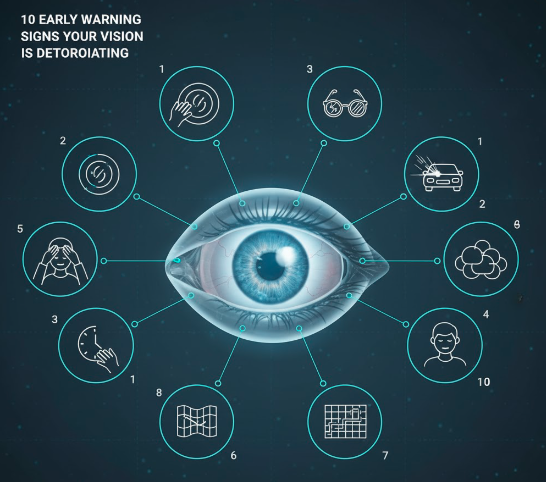
Is your eyesight trying to tell you something? Discover the 10 early warning signs of deteriorating vision you should never ignore. Learn the causes and the proactive steps you can take to protect your precious sight.
DISCLOSURE:
As an ClickBank Affiliate, I earn commissions from qualifying purchases made through links in this article. This income supports my research and content creation. Please understand that I recommend this product because I believe in its quality and benefits, and after conducting thorough research.

Your eyes are your window to the world. They allow you to experience life’s beautiful moments, from reading a favorite book to watching a sunset. But vision changes can be so gradual that we often dismiss them as normal signs of aging or temporary fatigue. However, ignoring these subtle signals can sometimes mean missing a critical window to protect your sight.
Many serious eye conditions are most manageable when caught early. This article isn’t designed to scare you, but to empower you. By understanding the early warning signs, you can take proactive steps to safeguard your vision.
Let’s explore the ten most common early indicators that your vision may need attention.
1. The World Is Getting Blurrier: Sudden or Gradual Blurriness
This is one of the most common and noticeable signs.
- What it feels like: Text on your phone or computer screen isn’t as sharp as it used to be. Street signs become difficult to read until you’re closer. Faces might look slightly out of focus. This blurriness can affect one eye or both and can be constant or come and go.
- What it could mean:
- Refractive Errors: This is the most likely cause. As you age, the lens inside your eye becomes less flexible, leading to presbyopia (trouble focusing on close objects, often after 40). Nearsightedness (myopia), farsightedness (hyperopia), and astigmatism can also develop or worsen.
- Cataracts: A clouding of the eye’s natural lens, cataracts cause vision to become progressively cloudy or foggy.
- Dry Eye Syndrome: Unstable tear film can cause intermittent blurry vision that often improves with blinking.
- Underlying Health Conditions: Uncontrolled diabetes (diabetic retinopathy) or high blood pressure can damage the delicate blood vessels in the retina, leading to blurriness.
2. Seeing the World Through a Fog or Haze
This is distinct from standard blurriness. It feels like you’re looking through a dirty or foggy window.
- What it feels like: Colors appear muted and lack their former vibrancy. You might feel like you need to constantly “wipe” your eyes to see clearly. This haze can make driving, especially at night, particularly challenging.
- What it could mean:
- Cataracts: This is a classic symptom of cataracts. The proteins in your lens clump together, creating cloudiness that scatters light, making everything appear hazy and dim.
- Certain Eye Infections or Inflammation: Conditions like uveitis can cause hazy vision along with other symptoms like pain and redness.
3. The Struggle with Night Vision
If driving at night has become a source of anxiety, it’s a sign worth noting.
- What it feels like: You need much brighter light to see clearly in dim conditions. Oncoming headlights cause intense glare or a “starburst” effect, making it difficult to see the road. It takes longer for your eyes to adjust when moving from a bright area to a dark one.
- What it could mean:
- Cataracts: The clouded lens scatters incoming light, dramatically increasing glare and reducing contrast sensitivity in low light.
- Vitamin A Deficiency: Vitamin A is essential for producing rhodopsin, a pigment in the retina that helps you see in low light.
- Retinitis Pigmentosa: This is a group of rare genetic disorders that affect the retina’s ability to respond to light, with night blindness being a primary early symptom.
4. The Appearance of Floaters and Flashes
While often harmless, a sudden change demands attention.
- What it feels like: Floaters look like tiny specks, cobwebs, or squiggly lines that drift across your field of vision. They are most noticeable when looking at a plain, bright background like a white wall or the sky. Flashes look like brief, lightning-like streaks in your peripheral vision.
- What it could mean:
- Posterior Vitreous Detachment (PVD): This is a common, age-related event where the gel-like vitreous in the eye pulls away from the retina. It often causes a sudden increase in floaters and flashes and is usually benign.
- Retinal Tear or Detachment: THIS IS A MEDICAL EMERGENCY. If the vitreous tugs too hard on the retina, it can cause a tear. A sudden shower of many new floaters, a curtain or shadow over your vision, or a significant increase in flashes could indicate a retinal detachment, which can lead to permanent vision loss if not treated immediately.
5. Difficulty with Peripheral Vision (Tunnel Vision)
Losing your side vision means you’re missing critical visual information, which is a major hazard for driving and walking.
- What it feels like: You might start bumping into objects on your side. It can feel like you’re looking through a tube or tunnel. People may seem to “appear” out of nowhere when they approach you from the side.
- What it could mean:
- Glaucoma: Often called the “silent thief of sight,” glaucoma typically damages peripheral vision first, and the change is so gradual that it goes unnoticed until significant, irreversible damage has occurred.
- Stroke: A sudden loss of peripheral vision can be a sign of a stroke affecting the part of the brain that processes vision.
- Retinal Detachment: As it progresses, it can create a shadow that affects the side vision.
6. The Challenge of Double Vision (Diplopia)
Seeing two images of a single object is disorienting and dangerous.
- What it feels like: Double vision can be monocular (present in one eye only) or binocular (present only when both eyes are open). A simple test: cover one eye. If the double vision disappears, it’s binocular. If it persists, it’s monocular.
- What it could mean:
- Monocular Double Vision: Often related to a problem within the eye itself, such as astigmatism, dry eye, or a developing cataract.
- Binocular Double Vision: This is more serious and can indicate issues with the muscles controlling eye movement or the nerves that control them. Causes can include Graves’ disease, myasthenia gravis, or neurological conditions like a stroke or aneurysm.
7. Frequent Changes in Your Prescription
If your eyeglass or contact lens prescription seems to be on a constant rollercoaster, it’s a red flag.
- What it feels like: You find that your current glasses are no longer strong enough after just a few months. You’re visiting your optometrist for new prescriptions much more frequently than in the past.
- What it could mean:
- Uncontrolled Diabetes: High blood sugar levels can cause the lens of the eye to swell, changing its shape and focusing power, leading to rapid vision changes.
- Cataracts: As a cataract develops, it can cause progressive nearsightedness, requiring frequent prescription updates.
8. A Sense of “Having a Shadow” Over Your Vision
This is a very specific and concerning sensation that should never be ignored.
- What it feels like: It’s as if a dark curtain, veil, or shadow is descending over part of your visual field, either from the side or from above. It may come and go at first.
- What it could mean:
- Retinal Detachment: This is a hallmark symptom. The shadow corresponds to the part of the retina that has detached and is no longer functioning.
- Stroke or Transient Ischemic Attack (TIA): A temporary loss of vision in one or both eyes, often described as a shade coming down, can be a sign of a “mini-stroke.”
9. Persistent Eye Pain, Redness, or Headaches
While often related to strain or infection, chronic discomfort can signal deeper issues.
- What it feels like: Aching, throbbing, or sharp pain in or around the eye; a feeling of grittiness; persistent redness; or headaches that seem to originate from behind your eyes, especially after reading or screen time.
- What it could mean:
- Acute Glaucoma (Angle-Closure): Sudden, severe eye pain, redness, headache, and seeing halos around lights is a medical emergency.
- Optic Neuritis: Inflammation of the optic nerve can cause pain with eye movement and temporary vision loss.
- Digital Eye Strain: Prolonged screen use leads to reduced blinking, dry eyes, and eye muscle fatigue, causing pain and headaches.
- Uncorrected Vision Problems: Straining to see clearly because your prescription is wrong can lead to significant eye strain and tension headaches.
10. Difficulty Perceiving Colors and Contrast
The world may seem to be losing its luster.
- What it feels like: Colors, particularly blues and purples, may appear washed out or faded. It becomes harder to distinguish between colors of similar shades. You might find it tricky to see a dark blue sock on a black floor due to reduced contrast.
- What it could mean:
- Cataracts: The clouded lens acts like a yellow or brown filter, dulling color perception.
- Macular Degeneration: The macula is responsible for central vision and color perception. As it deteriorates, colors can become less bright and contrast more difficult to see.
What To Do If You Experience Any of These Signs
Step 1: Don’t Panic, But Be Proactive.
Many of these signs are treatable, especially when addressed early. The worst thing you can do is ignore them.
Step 2: Schedule a Comprehensive Dilated Eye Exam.
This is non-negotiable. A routine vision screening for glasses is not enough. A comprehensive exam allows your eye doctor (optometrist or ophthalmologist) to look inside your eyes at the retina, optic nerve, and blood vessels, checking for signs of disease that you can’t see yourself.
Step 3: Adopt a Vision-Healthy Lifestyle.
While you can’t control all risk factors like age and genetics, you can control your lifestyle.
- Nutrition: Feed your eyes the nutrients they crave. Research has shown that specific nutrients are crucial for eye health:
- Lutein & Zeaxanthin: Found in leafy greens like kale and spinach, these pigments form the macular pigment, protecting your central vision and acting as a natural blue light filter.
- Vitamin C: A powerful antioxidant that supports the blood vessels in your eyes and may reduce the risk of cataracts.
- Vitamin E: Protects eye cells from damage caused by unstable molecules called free radicals.
- Zinc: Helps transport Vitamin A from the liver to the retina to produce melanin, a protective pigment.
- Omega-3 Fatty Acids: Support the structural integrity of retinal cells and help combat dry eye.
- Wear Sunglasses: Protect your eyes from harmful UVA and UVB rays, which can contribute to cataracts and macular degeneration.
- Manage Screen Time: Follow the 20-20-20 rule: every 20 minutes, look at something 20 feet away for at least 20 seconds.
- Control Underlying Health Conditions: Manage diabetes, hypertension, and high cholesterol with the help of your doctor.
Supporting Your Vision with Targeted Nutrition
We understand that getting all these nutrients from diet alone can be challenging in today’s busy world. This is where a high-quality, research-backed vision supplement can play a supportive role.
One such formula that has garnered attention is Sight Fresh. It’s designed to fill the nutritional gaps by providing seven vital bio-available fruit, flower, and bark extracts, along with essential vitamins and minerals.
Let’s look at how its key ingredients directly address the warning signs we’ve discussed:
- For Blurriness & Night Vision (Signs #1 & #3): Bilberry is packed with anthocyanins, powerful antioxidants that have been studied for their ability to improve blood flow to the retina and enhance night vision and visual acuity.
- For Dryness & Redness (Sign #9): Eyebright has been used for centuries in herbal medicine to help soothe irritation and reduce inflammation, providing relief for dry, itchy, or red eyes.
- For Blue Light Protection & Macular Health (Signs #4 & #10): Lutein accumulates in the macula, where it acts as a natural shield against blue light from screens and the sun. This helps protect the photoreceptor cells responsible for central vision and color perception, which are critical in preventing age-related macular degeneration.
- For Antioxidant Support (Signs #2 & #6): Vitamins C and E work synergistically to neutralize free radicals throughout the eye, protecting the lens from oxidative stress that leads to cataracts and supporting the overall health of the eye’s structures.
- For Foundational Eye Function (All Signs): Zinc is essential for transporting Vitamin A, a cornerstone of night vision. Copper is included to balance zinc levels and support the health of the optic nerve.
It’s important to note that Sight Fresh is a dietary supplement, not a medicine. It is not intended to diagnose, treat, cure, or prevent any disease. Its purpose is to provide comprehensive nutritional support for your eyes, just as a multivitamin does for your general health.
The formula is All-Natural, Non-GMO, and Gluten-Free, and it’s proudly manufactured in the USA in a GMP-certified, FDA-registered facility. Perhaps the most compelling aspect is the 180-day, empty-bottle, money-back guarantee, which allows you to try it with absolutely no risk.
Your Next Step Towards Clearer Vision
Your vision is one of your most precious senses. Recognizing these early warning signs is the first step. Taking action is the next.
If you’re experiencing any of these symptoms, your first priority is to schedule an appointment with a qualified eye care professional.
If you’re also looking for a way to proactively support your eye health with a comprehensive, research-backed nutritional supplement, we encourage you to learn more.


Ingredient Research Citations:
[1] https://pmc.ncbi.nlm.nih.gov/articles/PMC7866075
[4] https://pmc.ncbi.nlm.nih.gov/articles/PMC3485447/
[5] https://pmc.ncbi.nlm.nih.gov/articles/PMC1462955/
[6] https://pubmed.ncbi.nlm.nih.gov/14681716/
[7] https://pubmed.ncbi.nlm.nih.gov/7933422/
[8] https://pubmed.ncbi.nlm.nih.gov/22858124/
Disclaimer: This article is for informational purposes only and does not constitute medical advice. The information contained herein is not a substitute for and should never be relied upon for professional medical advice. Always talk to your doctor or a qualified healthcare provider about any health concerns you have or before starting any new supplement, diet, or fitness program.
READ ALSO THE ARTICLE TITLED:
How Alpha Surge Ignites Your Passion and Performance: A Science-Backed Breakdown
Leave a Reply